


Magazine Archive
Home -> Magazines -> Issues -> Articles in this issue -> View
Sample Shop | |
Article from Sound On Sound, October 1993 | |
Wilf Smarties gives a new batch of CDs a spin.
ARMANDO BORG/DNA BEAT BLOCKS •••••

From the home of the Clyde Stubblefield and Wilson Laurencin Drumming CDs comes Percussion Incognito, a collection of 700 loops, 175 samples, 700 MIDI percussion patterns and 10,000 Cubase groove templates. Only 10,000?
Track 1 on the CD opens with the title demo tune. Track 2 sets the tone for much of the CD: 'Tar Baby' offers nine conga loops centred around a single tempo (97 BPM in this case), each of slightly more than two bars. BPMs are given to two decimal places. Track 3 has nine bongo and a further five conga loops at around the same tempo. Track 4 has nice maracas, then the same bongo part is presented from several different mic perspectives. Curious. Track 5, with a dozen surdo loops, is well in order. Sensible stereo, too. Six has tambourine, agogo and woodblocks, 7 more congas, 8 exclusively agogos — all good stuff. Recordings are usually dry enough to please, though a variety of acoustics are offered; what digital reverb there is is thankfully used sparingly. I'm a sucker for shakers, and there are plenty on track 10 at around 120 BPM. Some more storming ones, and timbales, adorn track 17.
Playing tends to be more subtle than energetic, and many of the conga parts sound very similar — it's just the tempo that's changed. Some tracks (21, for example) have multiple voices, but usually it's down to Armando and one instrument.
There are some nice triangles and tambourines on track 22; I liked the mono loop, actually. More fill timbales, then it's on to the Guiro (or as we used to say, fish). Uncharacteristically, this is slightly spoilt by digital effects.
By track 40, I fancied I could detect a certain lack of flair in some of the playing. How would you feel churning out percussion parts in isolation ad infinitum? Using a sample CD can be less inspiring than hiring in a session musician. Still, £54.95 probably wouldn't buy enough time from Armando to enable him to set up his congas, far less play them!
Track 66 opens with some well warped bongoes crawling at under the national speed limit — really nice — and ends with a rare woodblock set in with surdo and almost as rare cabasa. More agogos, then more congas, tambourines, shakers and triangles. The last track of loops, 'Control Room', comprise studio-effected congas. Good, rather eastern sounding patterns and resonant cascades. More of these would have been welcome. From then on we're into single hits, clipped out of performances rather than specially hit, which, DNA claim (quite rightly), help them to sound more natural when sequenced. We are offered a finely tuned comprehensive set, again stereo, comprising numerous examples of each of the voices displayed in the loops (Agogo, bongo, cabasa, conga, guiro, maracas, pandero, shaker, shakerey, tambourine, timbale, triangle, woodblock) with a few other hits thrown in (rain stick, tick, claves, castanets, tumba, cowbell).
WHAT'S ON THE FLOPPY

I'm sorry, but I had no intention of auditioning 10,000 groove templates! Whoever heard of quantising a whole tune to the percussion, anyway? Surely the drums take precedence? OK: I suppose it would be valid if you want to customise the percussion loops by adding in single hits, but why 10,000? Don't get me wrong, I'm a fan of groove design, I just can't see many people (any?) needing more than one groove per loop.
Fortunately, that's exactly what you get in the form of MIDI files. Derived from the feel of the playing, these attempt to translate the subtleties of the percussion loops as best they can onto the coarse GM drum map. Unlike the 'templates', these are not Cubase-specific. Plus they can be used as parts in their own right. I checked some out using a Sound Canvas map installed in my S-770. Of course, they sounded just like sequenced Roland percussion, but the feel was there, ready to be mapped onto any pattern. There was a MIDI file for each track, with all loops simulated as a two-bar pattern. Just as it should be! Incidentally:
1. You can map dynamic as well as timing information by using the Q tool in Cubase: you can't do that using groove templates.
2. You can easily compose an arrangement track of groove patterns for quick quantising of relevant sections.
3. There were no bloody groove templates on the disk after all, despite the inclusion of a booklet explaining in detail how to use them! My advice to DNA: forget them. (Too late: They're available as an extra for masochistic programmers at a fiver. I can get eight bottles of Stella from Sainsbury's for that!)
4. An ASCII text file is included on the disk to help you get sorted.
5. Perhaps DNA would like to consider this suggestion: next time, instead of providing us with a range of tempos per track, why not resolve all the component loops to a median integer? Your audience will thank you for it.
Conclusion: patterns are not (thankfully) overbusy, playing is sound, and sound is natural rather than excitingly bright. Those of you who think that Latin Percussion is the TR727 might initially be disappointed. I think that the majority of the loops would sit nicely in, rather than inspire, a tune. Stereo is sometimes wide, sometimes narrow, and almost never silly. For tempos which tend around the ton, accelerating them would be well in order for club tracks, as the resulting pitching-up would give congas and so on more cut in the mix. This is the best and best presented general purpose percussion CD I've reviewed. With the highly usable (as it turns out) MIDI files it's a powerful product. My only serious criticism of the CD relates to the paucity of esoteric instrumentation. There wasn't a bell tree to be heard anywhere! Nonetheless, I'm going to recommend it to anyone who is not afraid of MIDI files. (Surely that means all SOS readers?) I do hope DNA see fit to release an African/Oriental equivalent some time in the future, to complement this Latin set.
FOOTNOTE: MIDIfiles are/will very soon be available for the Winston Laurencin and Clyde Stubblefield releases. If you have these CDs already, contact Time & Space. They'll be well worth having.
Percussion Incognito £54.95 inc VAT.
Time & Space, (Contact Details).
ALBIE DONNELLY'S KILLER HORNS •••••

The least contrived demo piece ever introduces this set from Albie Donnelly's Killer Horns. The ensemble are learning a riff over a backing track, just discernible in the cans. The sound is gigantic. A treat is obviously in store. PS: nice to see each set is Indexed.
Egghead Albie sports a ginger beard of ZZ-Top proportions. The sound of his horn section is even larger. His instruments are tenor and alto sax. With Dick Hanson (Trumpet/Fluegelhorn), Steve Crane (Trombone) and Paul Owens (Baritone Sax) he has assembled a frighteningly world class horn section.
Most samples are in well-miked stereo, and sound incredibly lively, pretty dry and upfront. I couldn't have done it better myself!
Track 2 kicks off a massive selection of common R&B ensemble cliches in a variety of keys. Well over 10 samples (on average) to a track, and all annotated for instrumentation, tempo, swung or straight playing, and key. Most licks are presented in major and minor keys where appropriate, and typically C, Eb, F# and A are addressed. You'll have to timestretch to fill the intervening keys.
Track 6 reveals authentic Specials riffs. I'm not sure what the copyright situation would be for those, but you would probably want to chop 'em up, anyway. Track 9 and the first black mark: little spots of distortion mar the otherwise succulent unison bones and flugelhorns. (Something similar cropped up on the trumpet tracks 34 and 35). Track 11 is mostly a comprehensive set of undemanding little licks featuring trumpet and tenor, though the Big Country lick crept in at the end. Track 12 starts off pure Spaghetti Western, and gets more sensible later. Pink Pantheresque short chromatic runs adorn Track 13 — and so on. The format is old favourites laced with simple riff sets. The opening to 'Big Spender' just went by...
Track 15 is a chromatic set of horn falls. Forget the Proteus, check these out! Track 16 has some fine staccato chops, and 18 opens with a big black low trombone/baritone riff (the one used in 'Rock Lobster'). A true monster. Track 19 has some fine smooth harmony work; there's Mega trills on Track 23. After a healthy dose of ensemble playing, the protagonists each get a chance to show us what they are made of.
Wonderful solo trumpet on track 27. What control! Track 30 and the first use of an effect — delay. Loved the damped trombone of tracks 39/40.
And so to Albie. Tenor work in the Junior Walker mould gives way to more mellow work. The baritone jumps in on track 46. If you need horns for a session and can afford them, buy these boys in. Albie and Paul puff away on their saxes all the way until track 90. Somewhere in the mid sixties I heard some weird stuff. By 79, we are back on the wild side. Percussive tonguing is quite an unusual noise to hear a sax make. Then again, 82 is soooo smoooth. Track 83 is in mono! Watch out for the two-note tenor/alto chords of track 85, and the squeals of 88. TIP: The best way to find suitable licks for your sequenced music from a CD like this is to loop the relevant bars, let the CD play in free time over the top, and note which samples seem to vaguely fit the mood.
There follows 21 massive multisampled sets, the largest of which contains 40 samples! There is a host of section short and long hits in every chord in the book, and semitone-interval sampled unison and seventh sets. Then there are solo instruments in a variety of dynamics, again sampled on every note. Goodness, but you've got your work cut out sampling these! It'll be worth it, but perhaps we'd have liked an Akai data section for this lot!
Conclusion: Over 1300 samples are all played with conviction. (Even the single notes for multisampling!) Tonality of instruments, precision of playing and recording engineering are generally world class. I suspect the few touches of distortion crept in during editing/mastering. The swells, falls, unison notes, chords and multisamples will be usable straight off the peg. Same for the improvisations and wild stuff. You will have to tinker with the industry-standard riffs by chopping them up if you want to disguise them. I can't see many sussed programmers using them wholesale. Marks out of five? Well, I loved Killer Horns, but to be fair I suppose I'll have to knock off something for that tad of distortion...
Other formats are soon to be made available of this release, including 'mixed mode' CD-ROM for Akai and EIII, and CD-ROM for Ensoniq samplers.
Best Service Albie Donnelly's Killer Horns £49.95 inc VAT.
Time & Space, (Contact Details).
UBERSCHALL: SPECIAL SOUND EFFECTS VOL. 1 ••••

Complete with a parental advisory warning concerning explicit samples, this collection of effects and atmos opens imaginatively with... a launch countdown. By the sound of the narrator, the umpteenth that day.
Seven hundred samples are indexed by track, number, and time and amongst the technical detail listed on the sleeve is a reference to DMP SPACE: for pseudo quad sounds all you have to do is connect a second set of speakers to your amp. Where have I heard that before? The dummy head mics do give mundane sounds like water pouring into a bucket a super-real quality...
The samples proper kick off with short atmos in a distinctly sci-fi, dungeons and dragons vibe. Creepy crawlies and mysterious machines are carved out of expensive and rare synthesisers and digital recordings. There is no point in my even trying to describe individual sounds to you: let me just say that they are layered through spatial effects, and are complex and high quality, particularly with reference to the bottom end (no intervening S1000) and stereo imagery. I will, however, mention a whine which persisted in the right channel for a number of samples (Tracks 6 and 7, for example). Even if it is a genuine FM synthesis overtone, I feel it should have been notched out.
Track 9, and the space drones are about as good as they get. Now we're in with the troglodytes. I liked very much the varispeed samples of tracks 12-14 — I get a similar effect by playing samples with the mouse on the EDIT 2 windows in my S-770. Doubtless these were done on a half-inch Studer.
Bleeps and Zaps loop and filter and waves sequence to provide the meat for 'Robots'. The 'Bangs and Booms' are typically fresh. 'Plastic + Paper' are obvious sound sources, or are they? Hindsight is a wonderful thing. The industrial section, pleasingly titled 'Work', is excellently recorded, capturing space and dynamics better than the competition — likewise the office set. I Liked the international operators, though Kraftwerk got there first by about a decade.
Hello to Lee McPhail, Synclavier driver for the BBC in Edinburgh. Last time I talked to him he was about to compile an entire CD of doors opening and shutting. Here such detail is not quite catered for, but there must be 60 or so to choose from. And if one of these doesn't quite hit the mark, try a different pitch. There are plenty footsteps, too, if you haven't got room for a sandbox.
Now you'd think that recording a bottle smashing would be easy as pie, wouldn't you? Well, apart from the mess and probable arrival of the Police by the tenth take, it's surprising how tiny it can sound. The trick is to record plenty reflected sound. These guys do it right.
Earth, Wind, Fire and Water are comprehensively and concisely represented. Also nice to hear some new bird and animal samples. The insect world is not forgotten, either (crickets and grasshoppers).
Epic adventure, a three-minute multi-oscillator low synth drone was set to test the reviewer's patience when after the first minute nothing much had happened. Then somewhere in the background some subtle filter cutoff manipulation added a little colour. Waiting for the punch line? There isn't one! There were a couple more of these Bladerunner backdrops.
This is the first sample CD to present the test tones as samples! The sine tones were probably from the console's oscillator: not quite theoretically pure. Thereafter came noise-bursts and digital tones, and wild sweeps and warbles. Loved the low rise. Pity about the little digital spikes.
And that was that, except that an alphabetical track index is included, cross-referenced to tracks. What a marvellously obvious idea. Other manufacturers take note.
Conclusion: Having put off reviewing this for a couple of weeks, I was pleasantly surprised. I was expecting 'more of the same', but the atmos, textures and hits had an angle to them, backed up by some excellent and creative engineering. If I'm looking for an atmos hit or short backdrop, I'll now be starting my search here. Many of these will become classics. PS. There's nothing in here I wouldn't play to Angus, so I don't know what the 'explicit' warning was for.
Special Sound Effects £59 inc VAT.
Advanced Media Group, (Contact Details).
UBERSCHALL WORLD PARTY 3 •••

This is a distillation from the Uberschall DAT-RAMs 1-3. It opens with around 80 female vocal ad-libs, unison and group, presented either dry or with a sensible amount of tight black box ambience to add presence. Material is sensibly ambiguous (yehs and oh-ohs, etc), much more usable than the silly season quotes on the Best Service Voice Spectral CD. Recording quality is excellent, and the session singers know the score.
There follow 20 or so heterosexual percussive vocal hits, once again sensibly avoiding words with more than one or two syllables. Then come six 'bedroom' noises with no erotic potential whatsoever. Bringing up the rear comes the weakest voice section, 'Talk Vox'. Guaranteed to be out of date before they go to print — I don't know why dance sample CD makers bother with them.
Onto the Loops. The presenters have decided to show off their programming expertise and effects rack rather than focus on giving you what you really want: good, clean, dry, authentic breakbeats and programming.
Instead it's hard to find a loop classic that hasn't been put through a panned chorus effect, had a tight reverb added, or been widened in some other way. That said, if you can live with the Uberschall production values (ready-to-run and not much scope for end-user sound designing) one has to admit that fidelity is good, and all loops are punchy and in stereo. And there are lots of them: around 200+. A good mix of programmed and off-D-record loops are offered, though Summer 1993 faves (Ragga etc.) are missed. In fact, the selection could have been compiled not long after Snap's 'I Got The Power'. File this loop collection under retro-Euro-techno.
Arghh! Fifty or so mega-rapid turntable scratches. I guess there will always be a place for hits like these. There will also be a punk band still playing in one Eastern European country or other.
A quirky collection of hits follows. I picked out my fave: the big brassy jazz chords on track 41.
Short waves are available to anyone with a receiver. One sample was a gated sequence. This gave me an idea, which I've decided to keep to myself. Short wave radios were widely used in '60s electronic compositions, due to the paucity of synth engines.
The bass and synth samples which follow are nothing special, though 47:2 is ripe for chopping. Synth loops are variously terrible/OK/good.
Track 50 introduces a selection of around 70 world percussion loops. Some are straight recordings, others are sequenced cut-ups, one or two are essential. I'm not sure if I'd put chanting Egyptians through an autopanner myself.
Track 61 offers nine space atmospheres. These are crap. Atmo Vox are much bigger and better. Eastern and Gregorian sources are put through some interesting spaces. The harmonised/reversed effects of track 62 are a bit Dr Who, though.
After another load of pretty ordinary synth atmos and clean, though too-few-to-do-much-with acoustic guitar and sitar samples came a pleasant surprise: a fresh collection of 20 or so old brass hits.
Then I'm afraid it was back to more synth drones, mostly of no particular merit. One or two of the harder-edged tones are worth picking off, though.
An Akai data section brings up the rear. If you don't have an S1000, the sleeve says, you can just sample the audio fragments normally. If your head can stand the digital info noise that links all samples! Various drum machines are represented — RY30, TR909, DR550 — along with specially prepared House, Rap, Jazz, Rock and Pop, 'Analog Box', Tabla and percussion sets.
Conclusion: A mixed blessing, this CD. The Vox ad-libs are among the best I've heard, and the brass hits seem to have been overlooked somehow. However, loops are generally over-produced and a bit behind the times, and synths are mostly ordinary. Fidelity is fine, most samples are in stereo, and there are 1222 samples to sift through. Hard to score, so I'll just give it a pass mark.
World Party 3 £50 inc VAT.
Advanced Media Group, (Contact Details).
STAR DISPOSABLE NAPPY RATINGS
| Peaudouce | ••••• |
| Pampers | •••• |
| Togs | ••• |
| Changes | •• |
| Happy Shopper | • |
Publisher: Sound On Sound - SOS Publications Ltd.
The contents of this magazine are re-published here with the kind permission of SOS Publications Ltd.
The current copyright owner/s of this content may differ from the originally published copyright notice.
More details on copyright ownership...
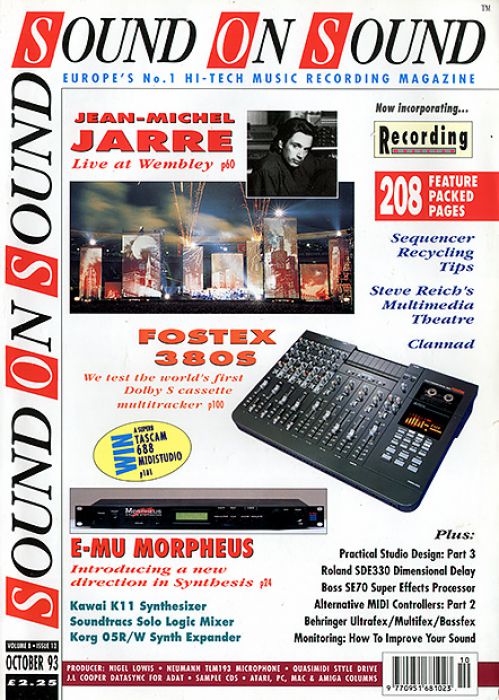
Sound On Sound - Oct 1993
Review by Wilf Smarties
Help Support The Things You Love
mu:zines is the result of thousands of hours of effort, and will require many thousands more going forward to reach our goals of getting all this content online.
If you value this resource, you can support this project - it really helps!
Donations for February 2026
Issues donated this month: 0
New issues that have been donated or scanned for us this month.
Funds donated this month: £0.00
All donations and support are gratefully appreciated - thank you.
Magazines Needed - Can You Help?
Do you have any of these magazine issues?
If so, and you can donate, lend or scan them to help complete our archive, please get in touch via the Contribute page - thanks!
Please Contribute to mu:zines by supplying magazines, scanning or donating funds. Thanks!
Monetary donations go towards site running costs, and the occasional coffee for me if there's anything left over!

 @mu_zines
 RSS Feed
 Blog
Blog