


Magazine Archive
Home -> Magazines -> Issues -> Articles in this issue -> View
Tascam MTS30 | |
MIDI SynchroniserArticle from Music Technology, May 1988 | |
As tape synchronisation becomes an indispensable part of modern music making, the demand for cost-effective sync boxes grows... Simon Trask discovers that it takes more than Tipp-Ex on the tape to throw the MTS30 off the track.

TECHNOLOGY MOVES FAST. The advent of budget SMPTE/MIDI synchronisers during the last year has taken digital timecode out of the professional audio and audio/video studios and into the proverbial bedroom. These budget units (by Syncrolab, XRI and Bokse) make it possible to record taped and sequenced parts in any order, and to start recording at any tape or sequence position.
With such flexibility readily available, it might seem that analogue FSK sync code has had its day. Yet there's one area in which FSK potentially scores over SMPTE, namely tempo changes. Whereas the cheaper SMPTE/MIDI synchronisers allow you to define 10 tempo changes at most (Syncrolab's SMC1.0 only allows an initial tempo), FSK sync code automatically encodes tempo (and consequently tempo changes) received from a sequencer - no matter how many there are. The possible disadvantage of FSK is that you have to decide on the structure and tempi of a piece before you start recording the tape parts.
But perhaps the biggest distinction between SMPTE and FSK has been the latter's inability to convey information on position - until now, that is. Despite eschewing SMPTE in favour of the more humble FSK, Tascam's MTS30 MIDI Tape Synchroniser can locate a sequencer to any tape position as effectively as a SMPTE/MIDI synchroniser.
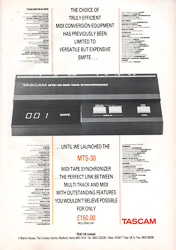
The MTS30 is a compact, lightweight unit with an uncluttered front panel; the rear panel offers MIDI In, Out and Out/Thru sockets together with tape in/out phono connections. Tascam's synchroniser operates in two modes, Save and Load (FSK write/read respectively), and could hardly be any easier to use.
In both modes the MTS30 displays a running bar-count in its three-digit LED window, based on the time signature that you select in Save mode. The unit defaults to 4/4 time on power-up, but can be switched to 3/4, 4/8 or 6/8 by successive presses of the middle front-panel button.
Clearly the bar-count will have little relevance if you're using irregular metres, or changes in time signature, but it does have a more important use. Tascam aren't about to divulge how they've managed to get an FSK unit to locate to tape position, but I'd hazard a guess that the MTS30 interleaves a bar-count (based on the chosen time signature) with the FSK signal on tape, and when locating to the tape on playback, it cross-references bar number and time signature to derive an absolute position which is communicable via MIDI.
What really matters, of course, is whether or not the MTS30 succeeds in the job it sets out to do, and here the answer is a resounding "yes". Recorded onto tape at the suggested optimum level of 0VU, the synchroniser's FSK signal proved to be unshakeable (and this on a budget portastudio with Dolby B noise reduction unable to be switched out). Total lock-up time at any point within a piece is 1-2 bars (the absolute time depends on the tempo and the time signature). Attempts to outwit the MTS30's locate feature were all to no avail; tape and sequencer remained perfectly aligned despite more shuttle operations than the US space programme and more dropouts than the University of California. Nothing fazes this device short of cutting the tape in two.
FSK code's automatic tempo-recording really comes into its own on Tascam's synchroniser, which handles subtle and extreme tempo changes with equal ease. I should point out here that tempi must initially be defined within the sequencer (in contrast to SMPTE/MIDI synchronisation, which requires tempi to be defined onboard the synchroniser); fortunately this is possible with many sequencers nowadays. Similarly, if you are to make use of the MTS30's locate feature, your sequencer must be able to respond to MIDI song position pointers (again, most do - but, for instance, budget Atari sequencers such as Dr Ts MRS and Microdeal's Super Conductor don't). If you want to record parts into your sequencer whilst slaving it to tape, you'll need to add on a MIDI merge box, as the MTS30 doesn't have the necessary merge function built in (in contrast, this seems to be a standard feature on budget SMPTE boxes).
Ultimately, the SMPTE option can offer more possibilities than FSK, but when it comes to the flexibility of being able to specify multiple tempo changes, at the budget level it's FSK that has the upper hand - at least when it also has SMPTE's ability to locate to tape position, as on the MTS30. The chief restriction of FSK is that tempo is fixed as soon as you stripe the tape with code, but there again you don't have to worry about storing SMPTE start and cue points.
Tascam's synchroniser is impressive for its simplicity, its reliability and its flexibility. In the general rush to "go SMPTE", don't ignore the MTS30; it really is rather good. In fact it's so good that it almost stopped me from taking my lunch-break. Technology moves fast. But not that fast.
Price £150 including VAT
More from Teac UK Ltd, (Contact Details)
Related reviews: Synchrolab SMC 1.0 (MT August '87); XRI XR300 (MT January '88); JL Cooper PPS1 (MT December '87); Steinberg Time-Lock (MT January '88).
Publisher: Music Technology - Music Maker Publications (UK), Future Publishing.
The current copyright owner/s of this content may differ from the originally published copyright notice.
More details on copyright ownership...
Music Technology - May 1988
Donated & scanned by: Mike Gorman
Gear in this article:
Synchroniser > Tascam > MTS30
Review by Simon Trask
Ads for Gear in this article:
Help Support The Things You Love
mu:zines is the result of thousands of hours of effort, and will require many thousands more going forward to reach our goals of getting all this content online.
If you value this resource, you can support this project - it really helps!
Donations for February 2026
Issues donated this month: 0
New issues that have been donated or scanned for us this month.
Funds donated this month: £0.00
All donations and support are gratefully appreciated - thank you.
Magazines Needed - Can You Help?
Do you have any of these magazine issues?
If so, and you can donate, lend or scan them to help complete our archive, please get in touch via the Contribute page - thanks!
If you're enjoying the site, please consider supporting me to help build this archive...
...with a one time Donation, or a recurring Donation of just £2 a month. It really helps - thank you!

 @mu_zines
 RSS Feed
 Blog
Blog